Stock market indexes, from the S&P 500 to the world
On this page
A stock index is a score for a group of stocks, such as the 500 largest U.S. companies. The Indexes page lists the main ones for the United States and the world, and leads to the complete families of indexes from the companies that publish them.
#The overview
Open Indexes in the Finance section bar.
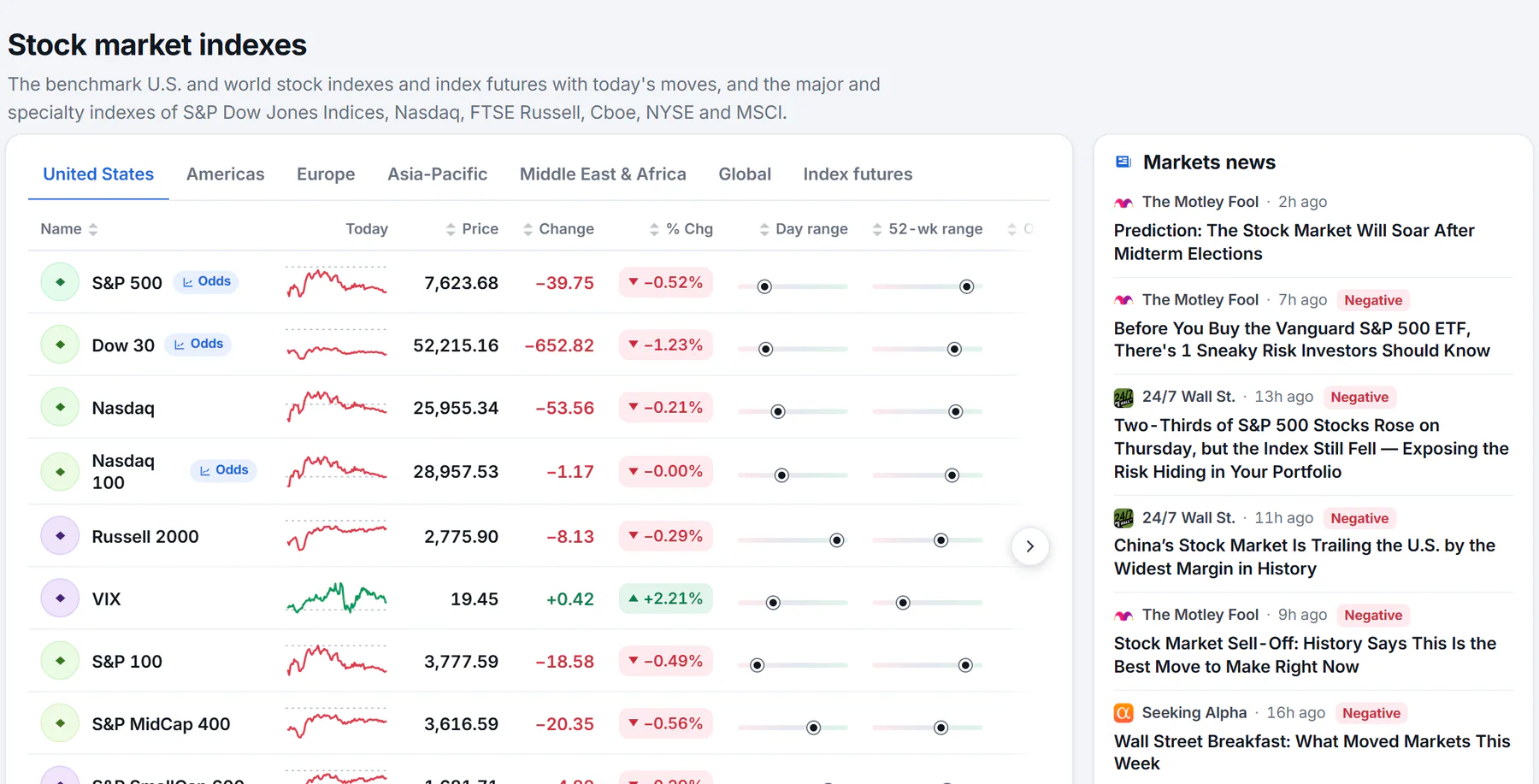
One tab per region. Select an index to open its page.
- 1Choose a region, or index futures
- 2Select an index to open its page
- 3Where the index sits in today's range
The tabs are United States, Americas, Europe, Asia-Pacific, Middle East & Africa, Global and Index futures. Each row shows the index's level, today's change in points and percent, a small chart for the day, and range bars. Where a tab holds indexes from several countries, the country appears under the name. See Sort tables and read the range columns.
A regional tab ends with a link such as All 20 European indexes, which opens the region's full page. Select a name to open that index's own page; see Funds, indexes, coins and currencies.
Index futures are contracts on where an index will stand later. They trade almost around the clock, so they often move before the stock market opens.
#Browse by publisher or region
Under the table are two groups of tiles.
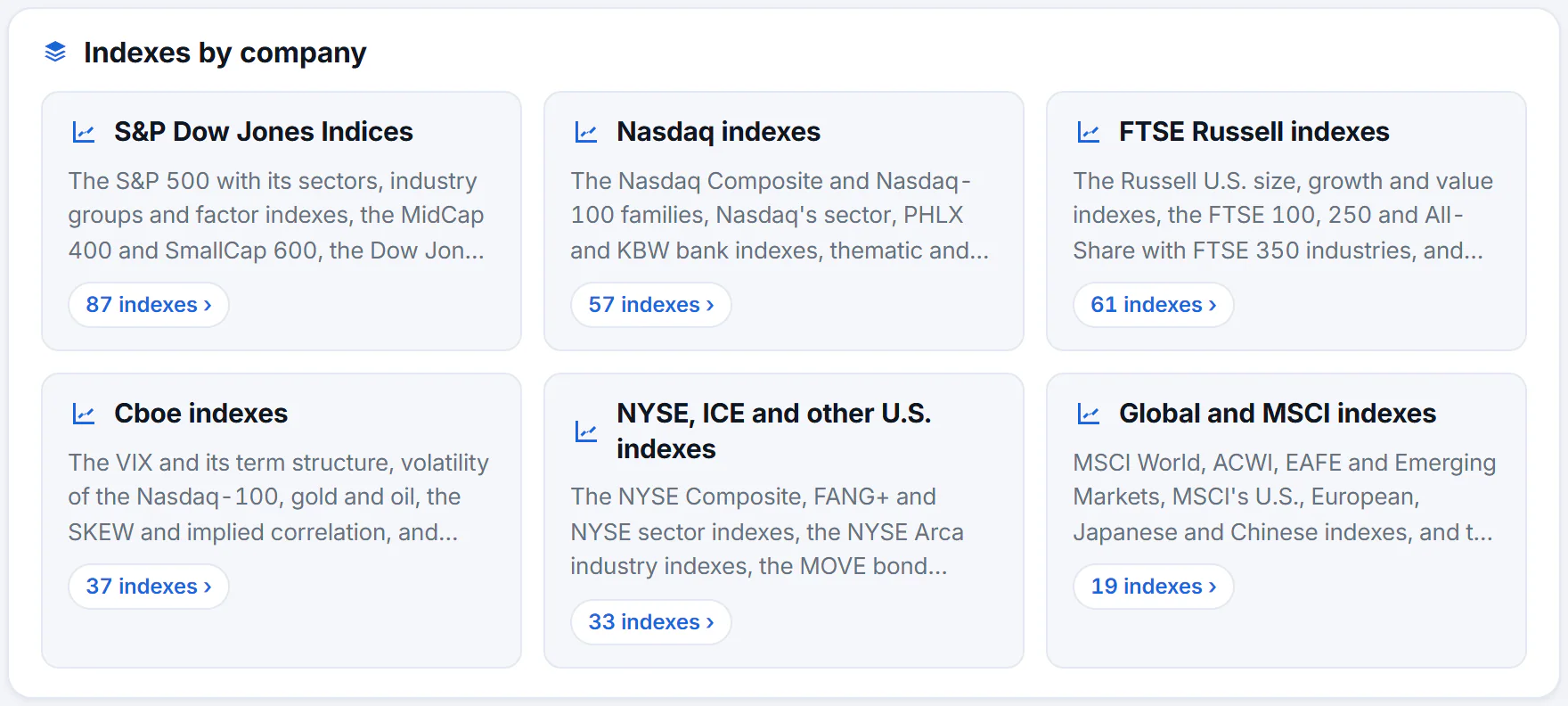
Each tile is one publisher with a short description and the number of indexes it has.
- 1One tile for each index provider
- 2Open the whole family
- Indexes by company: S&P Dow Jones Indices, Nasdaq indexes, FTSE Russell indexes, Cboe indexes, NYSE, ICE and other U.S. indexes, and Global and MSCI indexes.
- Indexes by region: the Americas, Europe, Asia-Pacific and Middle East and Africa.
A tile opens a page with a card for each family of indexes. For example, S&P Dow Jones Indices has The S&P 500 and size, Style, factor and strategy and S&P 500 sectors. A list at the right, More indexes, links to the other pages.
#Common questions
What is the difference between the Dow, the S&P 500 and the Nasdaq?
They are different baskets. The Dow follows 30 large companies. The S&P 500 follows 500 large U.S. companies. The Nasdaq follows the stocks listed on the Nasdaq exchange, which is heavy in technology. Select any of them to see its page.
Why is an index measured in points, not dollars?
An index is a calculated score, not something you can buy. Funds that track an index have prices in dollars.
Can I buy an index?
Not directly. People usually buy an exchange-traded fund or an index fund that tracks it. Finance does not sell or trade anything.